What Is a Training Consultation and Assessment Workout?
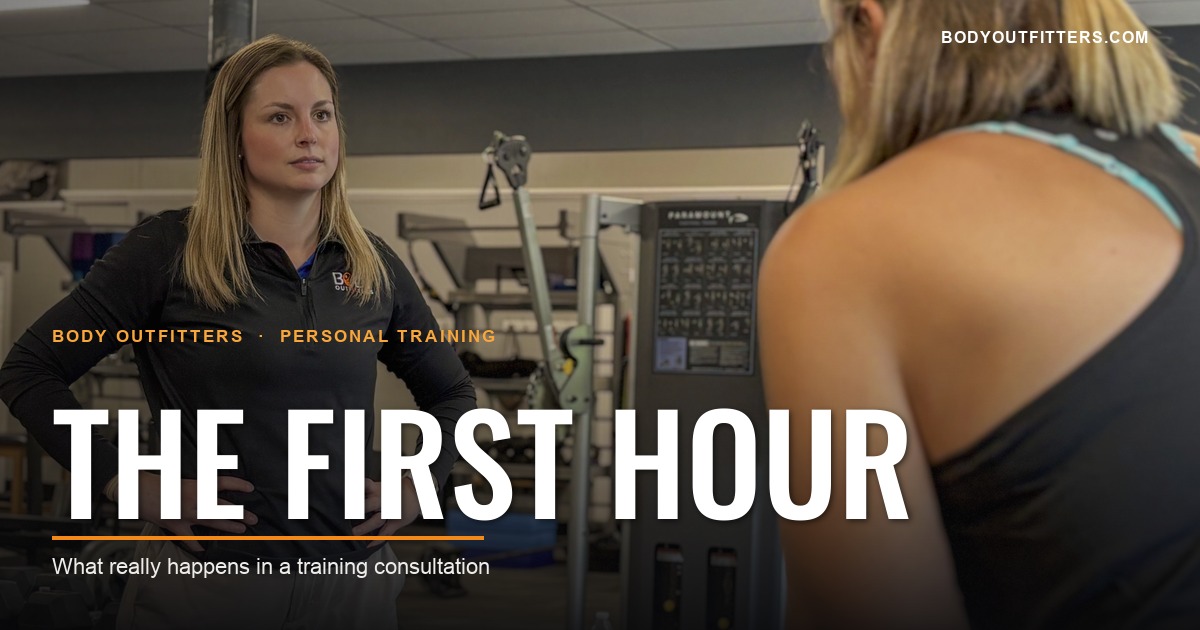
“A lot of our people stand on our black mat for the first time, and it takes some guts to do that. This isn’t an ice cream shop. You’re asking for help with something that can feel deeply personal, your body, how you move, how you feel.” – Mark Moreland Owner, Body Outfitters
What Is a Training Consultation and Assessment Workout? How Body Outfitters Builds a Personalized Workout Plan From Day One
A training consultation asks something of you before it gives anything back: real courage. It takes real courage to walk into a personal training studio. That is exactly why every new client at Body Outfitters starts the same way, with a training consultation and assessment workout. Two things happen in that one meeting: a real conversation, and a trainer watching how your specific body actually moves. Not a form. Not a guess. If you have looked up a personal training consultation and wondered what actually happens once you walk in, this is exactly how it works, and why it works this way.
What a Training Consultation and Assessment Workout Is
The first hour splits into two parts, in a specific order, and that order is the entire point.
First comes the consultation, the sit-down conversation. A Body Outfitters trainer works through three questions with every new client:
- Where are you now?
- What have you tried in the past?
- Where do you want to go?
None of that is small talk. “Those three are very important for a trainer building the next steps, especially the next steps after the assessment workout,” Mark says. Where you are now tells a trainer your true starting point, not the one you assume or the one you wish were true. What you have tried in the past tells a trainer what has already failed you, so it does not get repeated. Where you want to go is the target everything else gets built toward. Skip any one of the three, and a trainer is designing a plan half blind.
Then, in that same session, the conversation becomes movement. This is the assessment workout: a trainer watches whether you can get into the right positions for the exercises your program is going to need, and helps you find them if you cannot yet. Most people can, with a little coaching, a little cueing, or a small regression. Once a trainer sees a position held with real stability, weight gets added. That is the exact moment an assessment turns into a workout.
“We’re looking at where the stability and the range of motion start to break down,” Mark says. “We want margin in that first workout. We don’t want to run you all the way to failure.” That margin is deliberate. The first session is not a test of how much you can take. Instead, it is meant to leave you with a clear read on what to expect, from the intensity to the conversation itself, and walking out with enough left in the tank to be genuinely excited about the next one.
What a Trained Eye Sees That You Cannot
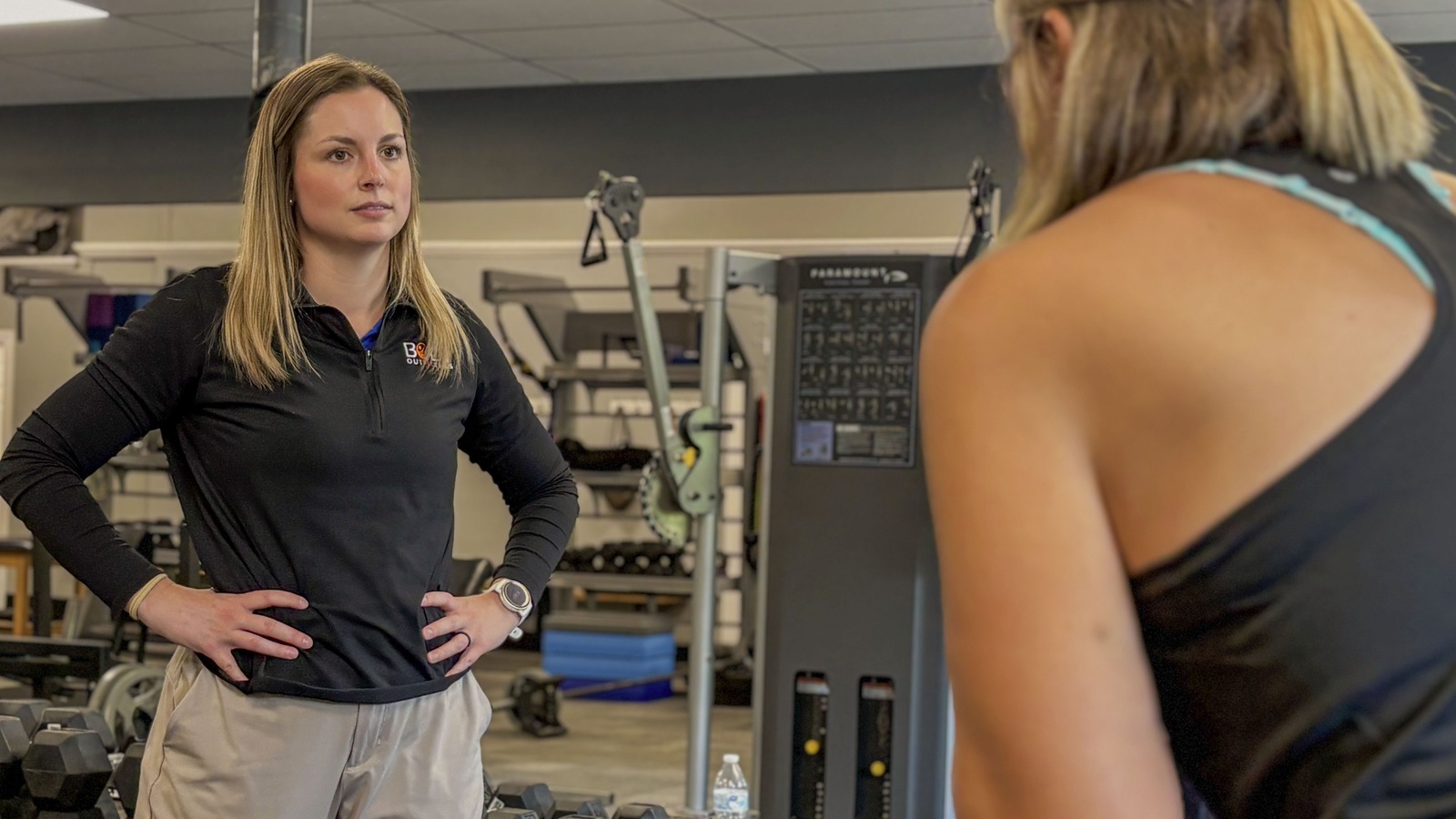 Every Body Outfitters trainer works through two lenses with a new client, and both have to be true at the same time.
The technical lens is pure mechanics: joints, geometry, how the body is built to move, almost as if you stripped away the skin and just looked at the machine underneath. The tactical lens is the person attached to that machine. Is there confidence in the movement, or hesitation? Is someone moving reluctantly because a movement is genuinely hard, or because their body has history with it that has nothing to do with today?
“If we only do the technical, we forget there’s a person attached to that,” Mark says. “The tactical part is working with the person that’s there, not just the machine.” Because getting only the mechanics right is not enough, a trainer has to read both at once, in real time, on someone they may be meeting for the first time.
A simple squat in front of a mirror shows this in action. Most people have never actually watched themselves move, and a hip that quietly shifts to one side is easy to miss from the inside. Body Outfitters calls this a favored side, and it is one of the first things a trainer looks for. “You don’t feel it, because your system has adapted to it,” Mark says. “The first question is what’s happening. The second is why.” That second question is where the real work starts, because a shift that shows up in a squat almost always traces back to something outside the gym entirely.
Parents who spend years carrying a kid on one hip develop a shift on that side without ever noticing it happening, their body naturally throwing weight underneath the load to counterbalance it. A desk job pulls the head and shoulders forward a little more every day, gravity working against good posture in a fight most people are quietly losing without realizing it. None of it has to hurt yet to be real. “If you have a bias in the system and we make you stronger without addressing it, we could be the reason it eventually becomes symptomatic,” Mark says. As a result, the risk of training hard without anyone watching how you move is real: strength gets built directly on top of a problem nobody caught, and the problem gets stronger right along with you. Catching it in the assessment, before it ever turns into pain, is the entire reason this step exists.
The Questions That Change Everything
Before anyone moves, a Body Outfitters trainer asks about your exercise history in real detail. Not to check a box on an intake form. “Good or bad, we still need to know it,” Mark says, “so we don’t repeat something that gave you a bad experience the first time. We want your first experience here to be a good one.” A history of bad experiences with exercise is common, and most of it is preventable the second time around, if someone actually asks.
Then come the injuries, every single one, no matter how minor it seems. The shoulder that has bothered you for years. The knee you have quietly learned to work around without ever mentioning it to anyone. Trainers push on this specifically. “This is your moment,” Mark says. “We want you to feel free to tell us every little thing. Our job is to take that and solve it, so we can be the reason it stops being a problem.” Most people downplay their own aches and pains out of habit. That question is designed to undo that habit, at least for the hour it takes to build a plan around the truth instead of around what someone assumes trainers want to hear.
Your Program, Built From What We Saw
Everything gathered in that first hour, every answer and every observation, goes directly into the plan that follows. Nothing gets borrowed from someone else’s program.
Known pain gets handled with real precision, not ignored and not pushed through blindly. “If your low back hurts, we ask exactly where. Above the belt or below, left side or right or both,” Mark says. “That tells us what to avoid in that first session. We’re not going to push on something you already expect to hurt. That’s not your fault, and it’s our job to work around it.” A back that hurts does not get mobilized first. Instead, it gets stabilized, teaching the deep core to hold and support that position on its own, because stability comes before mobility, every time, without exception.
That same precision carries into how the workout itself gets built. “We have a template, and it’s a good one,” Mark says, “but it’s still just a template.” A generic list of exercises applied the same way to everyone is not actually a plan, it is a starting shape. For example, take the squat. Trainers at Body Outfitters draw from roughly eight variations, and lean into the two or three that fit a given client best, so there is enough repetition to actually build real skill and track real progress instead of chasing novelty for its own sake. For a movement someone is not ready for yet, the approach is what Mark calls “regress until success,” find the version they can own completely, build real competence there, and only then move it forward. That is what separates a template from a plan. “I could run a template all day long,” Mark says. “I could run 50 people through it, and not one of those sessions would look, sound, or feel the same.” In other words, same starting structure, completely different execution, because it is built around a different person every time.
That philosophy carries straight into the second session. A client returns to loading what worked well the first time, one mobility assignment to build on, especially anything involving a hip or a shoulder, and a new movement or two layered in carefully, never an entirely new plan from scratch. There is also a level of trust being built in real time. Soreness between the first and second workout is not something to avoid, it is a connection point, a mild level one or two out of ten that lets you feel your own body responding and adapting. It should never last more than 48 hours. As Mark puts it, “it’s like good chili, if you warmed it up, it would actually be better.” A client’s willingness to push also tends to climb between sessions right alongside their trust, and a trainer plans around that curve on purpose rather than assuming everyone shows up ready for the same intensity on day one.
What Changes When You Start Here
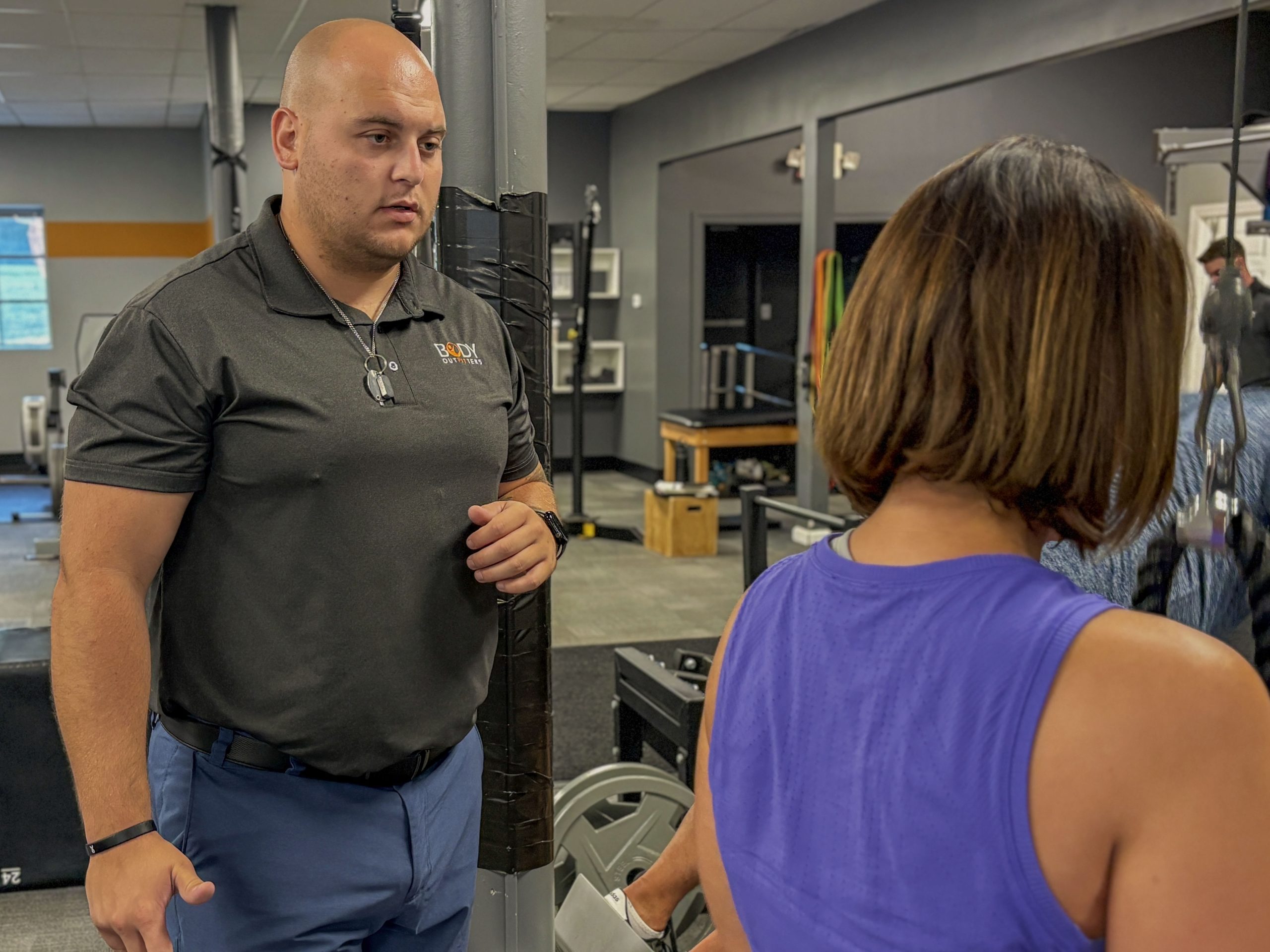 Skip the assessment, and you are guessing. So is whatever plan you are following, whether you built it yourself or found it somewhere online. “There are a lot of assumptions in fitness,” Mark says. “People think if you’re progressing in strength, you’re automatically getting better. But what are you actually strengthening? You could be building on top of something that’s working against you, and never know it, because nobody’s watching.” Getting stronger and getting better are not automatically the same thing. A 2025 study in the Journal of Strength and Conditioning Research found that people training under in-person supervision stuck with their program at nearly double the rate of those following a self-guided plan alone, 88 percent versus 52 percent. Consistency and outcomes both improve with someone actually watching how you move, not just what you lift.
Body Outfitters has run this exact process, a training consultation followed by an assessment workout, for over 16 years. “We know this,” Mark says. “Not just the order things happen in, but how to make it fit the person in front of us.” He is candid about what that first hour asks of someone, too, and he does not take it lightly. “Every person who walks in is making a commitment. They’re handing us their trust, sometimes a little hesitantly. We take that seriously.” People walk in carrying a lot: past failures, frustration, or just the feeling that it is finally time. That nervousness is real, and it is respected here rather than brushed past. As Mark likes to put it, “Ships are safe in harbor. But that’s not what ships were built for.”
Frequently Asked Questions
How long is a training consultation? Most first appointments take about one hour, including both the consultation and the assessment workout.
Do I need to be in shape before my first session? Not at all. The consultation is designed to meet you exactly where you are.
Will I have to work out hard during my first visit? No. The assessment workout is about learning how you move, not exhausting you.
What should I wear to a consultation workout? Comfortable workout clothes and athletic shoes.
Is the consultation workout free? Yes. Your first consultation workout is completely free.
Your First Step
Every personalized training plan starts with understanding the person behind it. That is why every new client begins with a training consultation and assessment workout. We learn how you move, what you have experienced, and where you want to go before building a plan that is actually built around you.
Your first consultation workout is on us. No pressure, no obligation. Just an experienced trainer, a personalized fitness consultation, and a clear starting point designed specifically for you.
Ready to see what a training consultation looks like near you? Find personal training in Carmel, Zionsville, or Keystone, or learn more about personal training and mobility classes at Body Outfitters.
Or schedule your first session today.